
Smart Publishing Assistant
Supports you in your publishing workflow with pre-selection, detailed analysis, correction recommendations, and metadata enrichment.
- 1Pre-selection
- 2Detailed analysis
- 3Correction recommendations
- 4Metadata enrichment

Time is money: Respond faster
Screen manuscripts faster, assess them thoroughly, decide promptly.
Scale your review processes
Evaluate more manuscripts without additional positions or extra workload.
More confidence in selection
Analytically grounded, transparently reasoned, clearly documented.
One tool for four key tasks
Manuscripts, exposés and sample chapters arrive — and you need to decide: assess, acquire, edit, market. narratiQ is with you every step: , , and .
Acquisition & Publication Process
narratiQ offers four dedicated modules:

Fast initial assessment
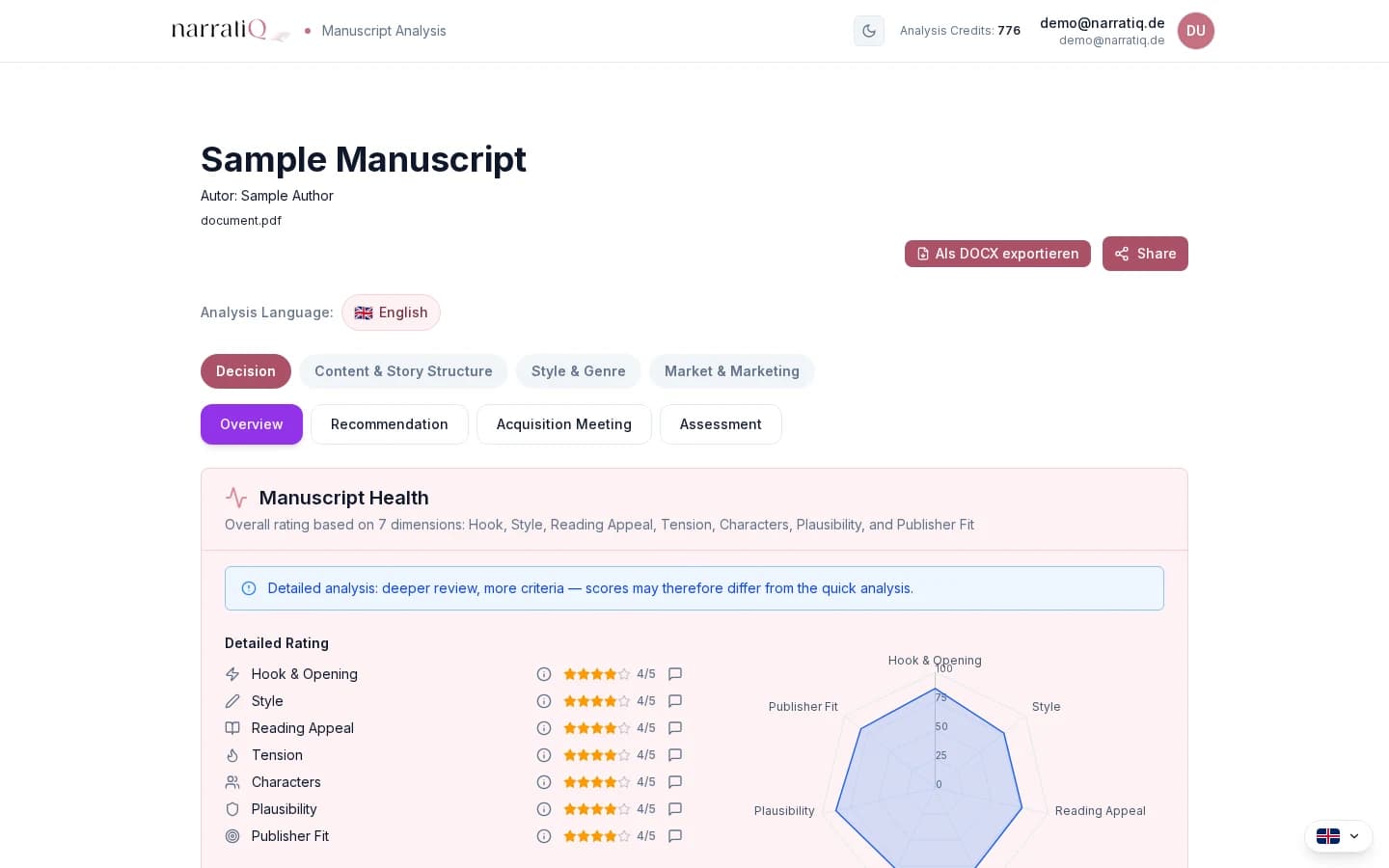
A manuscript arrives – narratiQ delivers a structured overview within minutes covering genre, style, characters, dramaturgy, target audience, and key strengths and risks. Instead of reading the manuscript, editors first review the analysis – and make an informed decision on the next step. Especially for sought-after titles being offered to multiple publishers, a faster signal can make all the difference.
- Earlier programme signals to agencies and authors
- Faster responsiveness to trending topics
- Fewer opportunity costs from misprioritised reading
Decide with confidence
The review goes into detail: structure, pacing, character development, story arc, style – backed by concrete text references. Editors read targeted, decision-relevant passages instead of the entire manuscript linearly. A vague impression becomes a transparent argument: not ‘the characters are flat’, but ‘Character X undergoes no recognisable development in chapters 3–7.’ The judgement stays with the editorial team – narratiQ structures and accelerates the reasoning.
- Reduced review time per title
- More titles reviewed per programme cycle
- Faster acquisition and committee decisions


Editorial assistance
After acquiring the manuscript, narratiQ supports the editorial process with prioritised notes – structured by chapter and visualised via heatmap. Editors add their own comments, set tasks, and keep track of progress. With each revision round, narratiQ shows what has been implemented, what remains open, and where new inconsistencies have emerged. The focus is on changes – not on re-reading the entire manuscript. A powerful tool for the editorial team – not a replacement.
- Clearer communication with authors
- Fewer coordination loops
- Documented revision status
Sales-ready metadata at the click of a button
Blurb, keywords, product group, BISAC and Thema codes – narratiQ generates all metadata directly from the manuscript. Platform-specific variants for Amazon, Thalia, VLB, Apple Books, Google Play and Kobo can be copied, edited and exported as ONIX 3.0.

From crime fiction to quantum physics.
Fiction
- Character development: Do the characters grow, or do they stay flat?
- Tension arc: Where does it hold, where does it drop?
- Style & tonality: Narrative voice, pacing and register in detail
- Genre deep analysis: Which conventions does the manuscript follow, which does it break?
- Trope detection: The key tropes at a glance
Non-Fiction
- Jargon → plain language: Complex terminology, clearly broken down
- Argument logic: Is the argument coherently structured?
- Source quality: Are claims substantiated, sources traceable?
- Fact check: Critical claims checked against current sources
From jargon to editorial language
“The study shows that 5-HT2A receptor agonism combined with psychotherapeutic support leads to significant reductions in MADRS scores, comparable to first-line SSRI therapy for treatment-resistant depression.”
“The book explains how psychedelics act on serotonin receptors in the brain. The central thesis: a single guided session can be as effective for severe depression as months of antidepressants — with fewer side effects.”
Your editor immediately understands what it’s about — without being a domain expert.
Automatic market comparison
narratiQ breaks down every manuscript into its core building blocks — genre tropes for fiction, central theses for non-fiction. Based on these, it finds comparable titles on the market: not by keyword search, but through content understanding. Which books address the same themes? How does the manuscript position itself competitively? What gap could it fill?
Two ways to use narratiQ
Standalone platform or seamless integration -- you decide.
Get started instantly
Upload manuscripts, run analyses, and access all results directly in narratiQ. No setup, no IT effort.
Try for freeIntegrate into your system
Connect narratiQ via REST API to PONDUS, knkVerlag, or your own system. Full control, full automation.
Explore the APINo AI training. GDPR compliant.
No AI training
Your manuscripts are not used to train language models. Microsoft guarantees this contractually for Azure OpenAI.
Processing in Europe
All data is processed exclusively in European Azure data centers. No transfer to the USA.
Deletion after 30 days
Processing data is automatically deleted after 30 days. Additionally, you have a GDPR right to deletion at any time.
Talk to us
Write to us — we'll get back to you within 24 hours.
Reach us directly
General inquiries
kontakt@narratiq.deSupport
support@narratiq.deResponse time: We typically respond within 24 hours on business days.
All benefits at a glance
Ready for informed manuscript decisions?
Let us show you in a personal demo how narratiQ strengthens your editorial team – or take a look at a real example analysis.