Analyse a book project once. Use it across the whole publishing house.
narratiQ gains from one book project the information that acquisition, editorial, positioning, metadata and marketing need: once, for everyone. The results feed into your existing workflow. narratiQ replaces neither your publishing system nor your team's judgment.
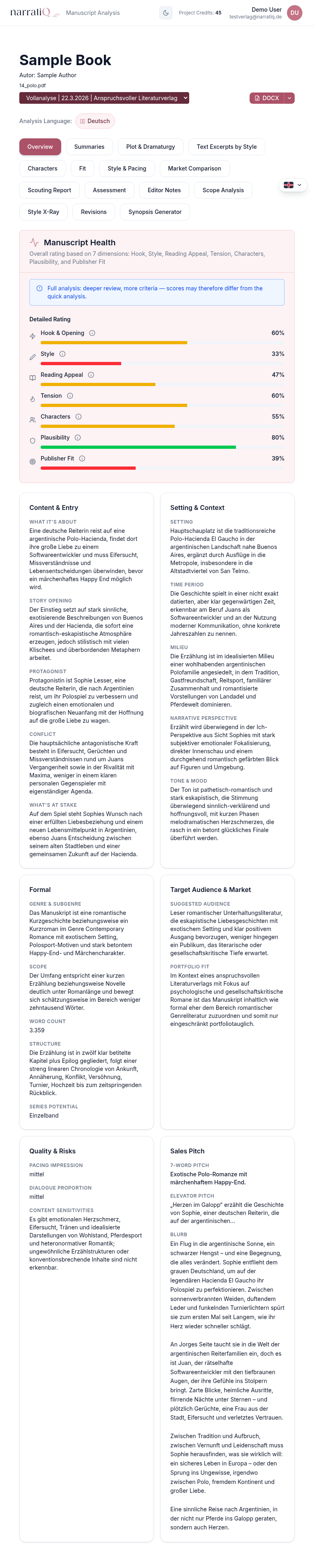
Four modules across your title workflow
From initial screening to sales-ready metadata: the same content analysis is reused for multiple tasks and can flow into existing publishing systems.
Acquisition & Publication Process
Before the editorial board meeting
Quick assessment
Manuscripts are structured, summarized and checked for initial strengths, risks and notable issues within minutes – as a consistent starting point for editors.
For the acquisition decision
Full reader's report
Publisher-profile fit, genre classification, comparable titles and market context provide verifiable arguments for the editorial board – supported by evidence from the text.
During manuscript development
Editorial assistance
Plot logic, consistency, character development, style profile and version comparison are prepared for focused work on the manuscript that matters.
Before sales and marketing
Metadata creation
Blurb drafts, positioning, keywords and selling points are derived from the existing analysis – without having to interpret the manuscript again.
When a field test is especially worthwhile
Rising submission volumes, open positions or repeated screening work make the benefit easy to measure – with real titles and within your existing process.
An editorial position is open
Filling an open position can take months. Structured pre-screening keeps the team operational without automating the professional decision.
More submissions, the same time
As agency material or submission volumes grow, a consistent decision dossier creates greater comparability and additional decision capacity.
Screening consumes quality time
Less repetitive initial assessment and material preparation means more time for author development, list fit and the editorial work itself.
What we keep hearing across the industry
If these situations sound familiar, the value of narratiQ can be tested in concrete terms.
Where narratiQ supports your publishing house
Four areas in which the same manuscript analysis prepares decisions and reduces duplicate work.
Fit with your publishing profile
narratiQ checks the manuscript against your stored publishing profile – list priorities, expectations, dos and don'ts. The question ‘Does this fit us?’ is assessed transparently against your own criteria.
Comparable titles and market context
Research from Amazon, Google Books and industry data connects the text analysis with your list logic: similar titles, segment, positioning and competitive environment.
Dramaturgy and story arc
narratiQ analyzes turning points, twists and the story arc across the complete manuscript. Findings are made verifiable with specific passages from the text.
Style profile and tone
Narrative stance, pace and linguistic characteristics become visible. Fit with the list can be discussed using evidence from the text.
More usable groundwork. More time for publishing judgment.
Your editorial team receives more consistent decision material and reusable results – leaving time for list fit, tone and author development, where human experience matters.
Groundwork, not replacement
narratiQ does not take any expert decision away. It prepares material so that your team reaches its own assessment faster.
Analyse once, use many times
The same analysis gives programme, editorial, marketing and sales their answers. No repeated research, no manual transfer.
Responsibility remains clear
Not an automated writing tool, not a substitute for judgment, and no training on publisher data. narratiQ provides structured guidance; the decision stays in-house.
Editorial mode – support throughout development
narratiQ supports not only list screening but also manuscript development: checking consistency, consolidating structural notes and comparing style analyses across versions.
Editorial mode is part of our current product development and is being shaped together with publishing editors.
Early partners shape the feature set around their real workflows and requirements.
What remains unchanged: professional responsibility lies entirely with your team.
Tone, list fit and author development remain human decisions. narratiQ handles groundwork so your editors retain time for them.
Test the value on one of your own book projects
Send us a title you have already decided on. We show you what narratiQ gains from it. No system change, no upfront commitment.
- Free of charge, up to three titles per publisher, for example one non-fiction and two fiction titles
- Results within 24 hours as a Word document or PDF
- Followed by a joint review: what did the analysis add to your current way of working?
We do not construct an artificial before-and-after comparison. Whether and where narratiQ takes work off your publishing house is for you to judge, on your own title.
We will show you using one of your own titles.
In a 30-minute first conversation we clarify what you want to test. Or you send us a book project right away: free of charge, results in 24 hours, no upfront commitment.